Can you believe it?
Biology sometimes offers us a view of the natural world more incredible than any trick.
April Fool’s is a day for pranksters, and a day of pervasive uncertainty for the rest of us. Despite our capacity for wit, few things we could invent can match the glorious ways that nature has subverted our expectations and pranked us with the truth. Here are three of our favorite stories of the surprises that evolution laid out for unsuspecting scientists. One can only imagine the clickbait-style headlines that may have run through their minds as they made their discoveries.
Bizarre beetle hydrates with nocturnal headstands
In the fall of 1975, two biologists, Mary K. Seely and William J. Hamilton III, camped in the Namib desert to stalk a solution to a quiet mystery: why do some toktokkie beetles come out at night and stand on their heads in the dunes?
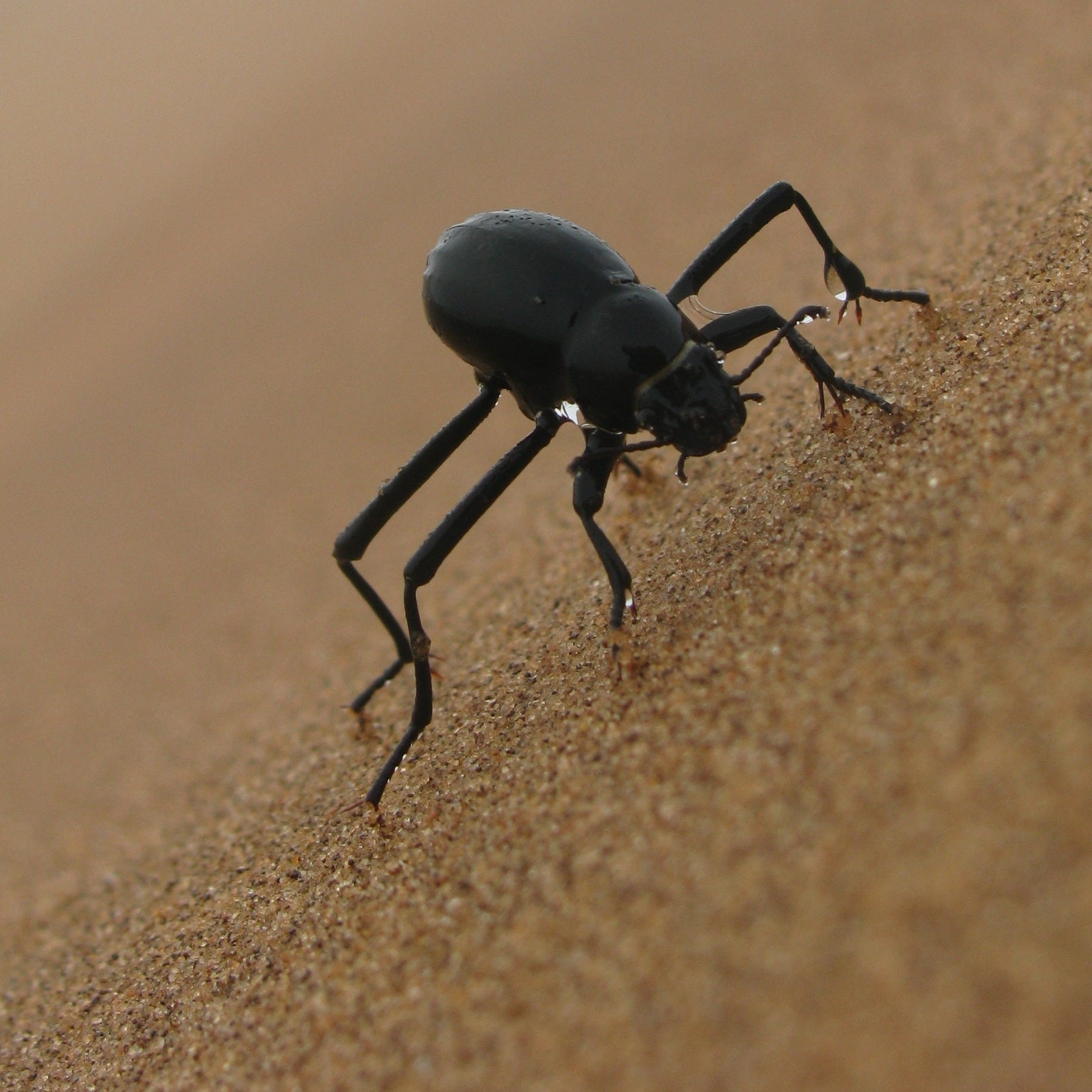
Seely and Hamilton watched each night as the beetles came out from their dens in the desert sand to stand on the crest of a dune, stretching their legs so that they accomplished a beetle version of a handstand. As they assumed this posture, a nighttime fog would roll in, and tiny drops of water would collect on the beetles’ waxy wings and roll down toward their heads.
The scientists suspected that the beetles were capitalizing on this gift of moisture in what is one of the driest regions of the world. But they were stunned by the scale of what these small insects were achieving. And a simple scale was the key to this discovery: by tagging the beetles with tiny number plates and weighing them before and after their midnight excursions, Seely and Hamilton confirmed that the beetles were drinking the water that condensed on their backs, catching it as it rolled down their grooved wings to their mouths. Some beetles drank as much as 34% of their own starting weight in water in a single night, storing it in an isolated cavity within their bodies to avoid diluting their body fluids too much.
The significance of this accomplishment and a similar behavior by related beetles were calmly reported in twin publications in Science and Nature the following year: “Observations of fog trapping have not been reported previously for any animal other than man.”
This boy bat has been mammary maxxing
The 1994 scientific correspondence to Nature from a team of biologists led by Charles Francis began in peculiarly suited style of the time:
“SIR- Although male lactation is physiologically possible, it is isolated and rare. It has been observed in domesticated mammals and in humans, but it has not been reported in wild, free-ranging species. Here we report lactation by males in a population of Dayak fruit bats . . . in the Krau Game Reserve, Pahang, Malaysia.”
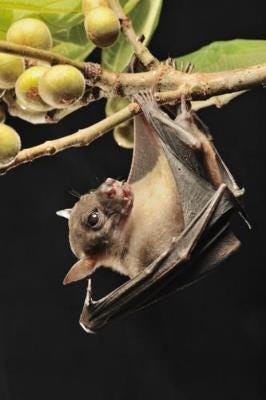
Francis and his colleagues had set up a simple mist net to catch and examine local bat species. They were, if we may so put it, mystified to discover that each of the ten mature male bats they captured had fully developed mammary glands. The glands were producing milk, and tissue samples confirmed that this capacity for lactation was occurring in bats with fully functional male gonads. This bat is evasive and challenging to study; subsequent years have not yielded an answer about how often fathers may nurse their young or the evolutionary and environmental factors that have enabled male lactation.
Pooping parrotfish build beaches by crunching up coral
Colorful parrotfish populate the ocean waters of the Indo-Pacific, living around coral reefs and rocky coastal regions. Their rainbow appearance and vegetarian natures feel contradictory to the source of their name: a beak-like mouth filled with an alarming number of knobby teeth. As if these weren’t enough, their throat is filled with another set of pharyngeal teeth just behind their powerful jaws.
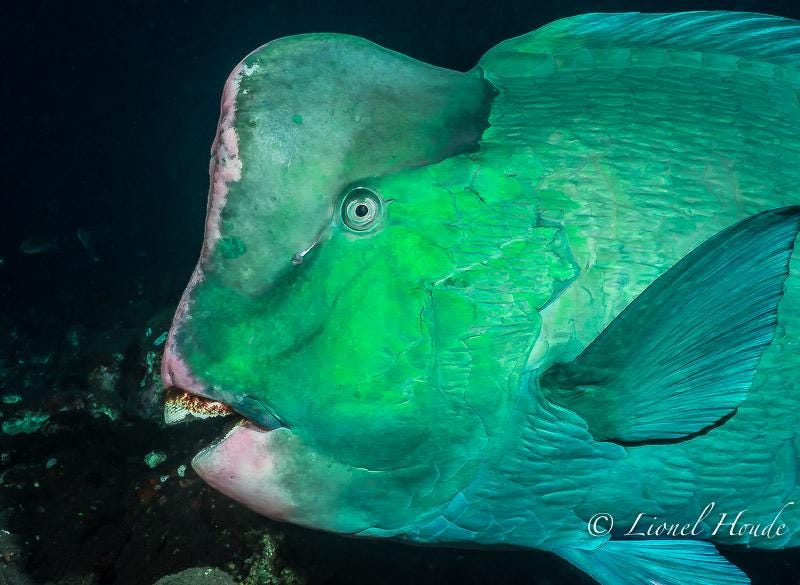
Why so many teeth? In 1996, marine biologist David Bellwood already knew the previous findings of parrotfish natural history: they feed on algae and microbial growths on rocks and coral, scraping and sometimes crunching the mineral substrates beneath them to extract as much flora as possible. What he documented in a series of dives in the Great Barrier Reef is the staggering volume of their coral consumption, and the resulting contributions to the marine environment. A humphead parrotfish can convert larger coral fragments and fresh bites of coral into as much as 1000 lbs of sand per year. That sand is carried away from the reef to wash up on island beaches. As we look out on rainy April weather, we can all imagine relaxing in the sun on the output of these industrious fish.
Parting thoughts
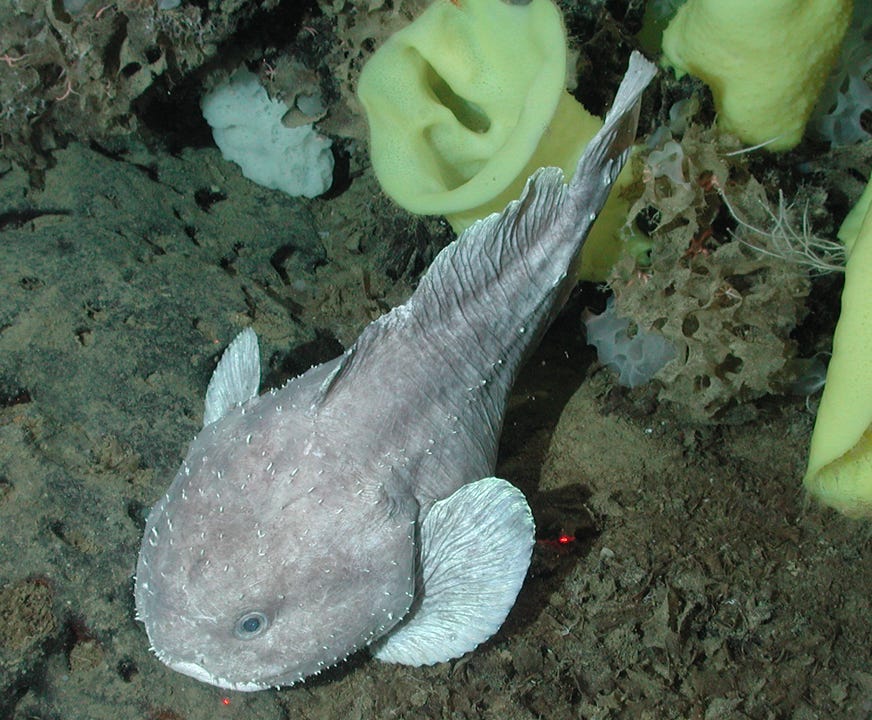
Sometimes we really shouldn’t believe what we think we see; or at least, we need to remember the ways that how we see something might contain bias. Diving deeper into Earth’s ocean waters, we find a reminder of this in the much-maligned blobfish.
Since their discovery in 2003 in a deep-sea species survey, blobfish have quickly built a reputation for charismatic hideousness. The subject of many an internet joke, they are actually fundamentally misunderstood. As we drag them up from the high-pressure depths to which they are exquisitely adapted, their fine-tuned tissues lose the context for their function. More simply put, when not under the high pressure of the deep sea, they simultaneously collapse and explode. In our effort to understand them, we accidentally change them into something else altogether. We must swim or scroll further to see them as they really are.